The IT training program at BlueCross BlueShield of SC (BCBSSC) is called the “Entry-Level Training Program” or ELTP. We started this program in 1997 and it was fashioned to give recent college graduates who had earned their degree in Computer Science or a related field, a career with BCBSSC Information Systems.
Entry-Level Training Programs are comprehensive; they include classroom and on-the-job training. Program duration is from 14-22 weeks. Everyone accepted into an ELTP is expected to successfully complete it. Upon completion, the incumbent will be a) assigned to a department where their skills will be put to use, b) expected to acquire additional knowledge and skills, and c) reclassified to the entry-level position appropriate for their area.
Currently, there are 4 distinct tracks: Application Development host and non-host systems, System Support and ICT*. ICT covers the areas of telephony, servers, networks and Z-Linux.
Application Development on the host systems (IBM system Z) provides training in systems development methodology, work request life cycles, job control language (JCL), COBOL, debugging tools, Application Productivity System (APS), databases and develop business problem solving skills; training lasts 14 weeks.
Application Development on the non-host systems provides training in web-applications; training lasts 14 weeks.
System Support is 18 weeks long and the courses cover web-based applications, network management, server management, system security, and other areas relevant to keeping our non-host applications functioning properly.
ICT covers training for network management, server management, system security, and other areas relevant to keeping our operations functioning properly. ICT training last 22 weeks.
This year, there will be 23 positions; 10 in Application Development for the host systems, 6 in the non-host systems, 4 for ICT and 3 in System Support. This opportunity is located in Columbia SC. Our next ELTP starts on May 28th.
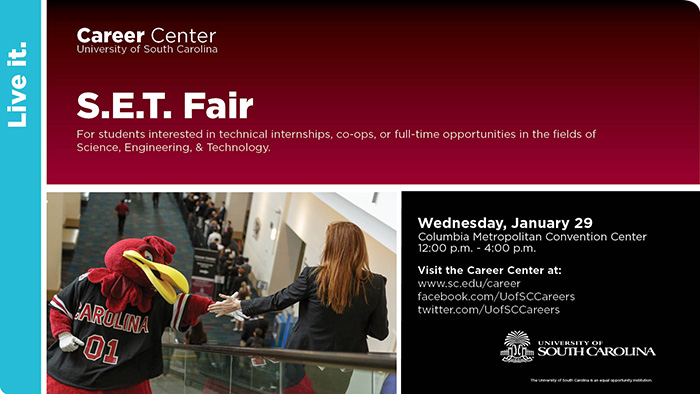
BCBS will be at the SET fair.
Barbara Eppink
BlueCross BlueShield of South Carolina
I/S Recruiting/SRM
803-264-1002
803-264-8096 (fax)
barbara.eppink@bcbssc.com
www.southcarolinablues.com



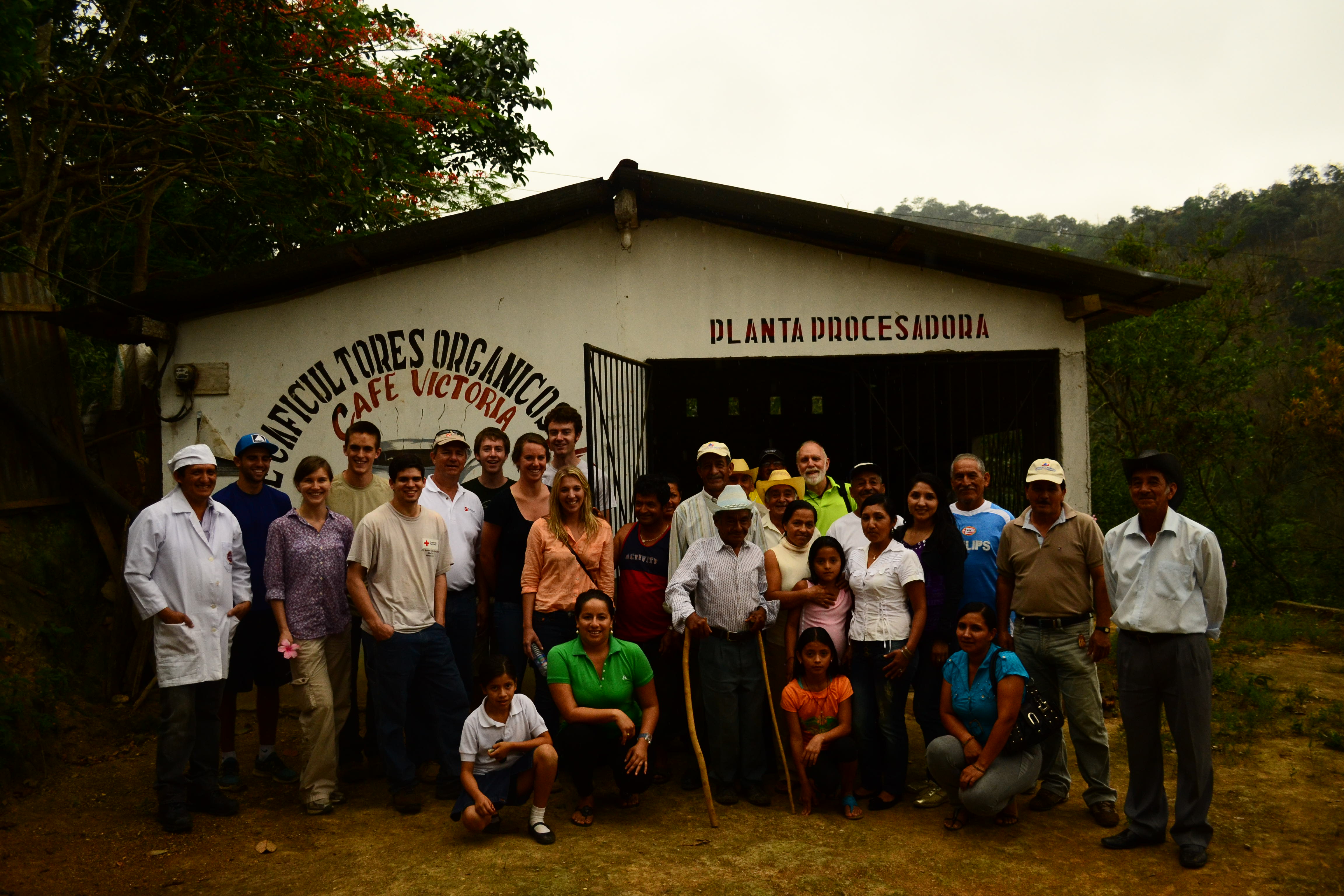 COLUMBIA, S.C. (Jan. 18, 2013)—From a university with a motto of “No Limits,” USC’s Engineers Without Borders are showing how their solutions for sustainable communities truly have no boundaries. Four members from the student organization used their winter break to begin working on a five-year program that will help develop a sustainable water supply system for an organic coffee plantation in La Victoria, Ecuador.
Alongside four project mentors, USC students Brendan Croom, Andrea Eggleston, Ronny Geylin and Corey King traveled to the developing country Jan. 2 through Jan. 12. This winter’s visit was the first of many to develop, implement and maintain the water system. The students received Magellan grants through the Office of Undergraduate Research to help fund their project. Croom, a third-year mechanical engineer major, helped coordinate the program.
“We were all really excited to work with the village,” said Croom. “The program has given me the opportunity to develop a cultural connection in a part of the world I normally wouldn’t have seen.”
The students visited with 23 farmers of a local coffee-growing cooperative (La Asociación de Caficultores Orgánicos de Las Lajas, or ACOLL) and local engineers. They even met with the mayor of Las Lajas. Croom said the group was able to establish strong relationships in the community they will be working so closely with in following years.
“Everyone was very willing and enthusiastic to work with us, and we see a lot of promise,” said Croom.
The student/mentor team collected data for the system design, which will create a pipeline that uses gravity to flow water two kilometers from a mountain spring to storage ponds near the coffee farms. They surveyed potential pipeline routes with GPS units, obtained topographic maps and consulted with engineers to discuss suitable design options.
The engineering students who continue with the project will use this data to develop and implement the system that will provide vital support to the Andean community’s agriculture. A new group of EWB members from USC will return to the location at the end of the summer to begin the next phase of the project.
For more information on Engineers Without Borders-USA at USC, visit the organization’s website at ewbusc.org. To learn more about education abroad opportunities, contact the Study Abroad Office at studyabroad@sc.edu.
COLUMBIA, S.C. (Jan. 18, 2013)—From a university with a motto of “No Limits,” USC’s Engineers Without Borders are showing how their solutions for sustainable communities truly have no boundaries. Four members from the student organization used their winter break to begin working on a five-year program that will help develop a sustainable water supply system for an organic coffee plantation in La Victoria, Ecuador.
Alongside four project mentors, USC students Brendan Croom, Andrea Eggleston, Ronny Geylin and Corey King traveled to the developing country Jan. 2 through Jan. 12. This winter’s visit was the first of many to develop, implement and maintain the water system. The students received Magellan grants through the Office of Undergraduate Research to help fund their project. Croom, a third-year mechanical engineer major, helped coordinate the program.
“We were all really excited to work with the village,” said Croom. “The program has given me the opportunity to develop a cultural connection in a part of the world I normally wouldn’t have seen.”
The students visited with 23 farmers of a local coffee-growing cooperative (La Asociación de Caficultores Orgánicos de Las Lajas, or ACOLL) and local engineers. They even met with the mayor of Las Lajas. Croom said the group was able to establish strong relationships in the community they will be working so closely with in following years.
“Everyone was very willing and enthusiastic to work with us, and we see a lot of promise,” said Croom.
The student/mentor team collected data for the system design, which will create a pipeline that uses gravity to flow water two kilometers from a mountain spring to storage ponds near the coffee farms. They surveyed potential pipeline routes with GPS units, obtained topographic maps and consulted with engineers to discuss suitable design options.
The engineering students who continue with the project will use this data to develop and implement the system that will provide vital support to the Andean community’s agriculture. A new group of EWB members from USC will return to the location at the end of the summer to begin the next phase of the project.
For more information on Engineers Without Borders-USA at USC, visit the organization’s website at ewbusc.org. To learn more about education abroad opportunities, contact the Study Abroad Office at studyabroad@sc.edu. Know how to program ? Want to study the ocean?
The Marine Trace Element Lab at USC seeks an undergraduate research assistant to help modify Fortran code for an existing Global Climate Ecosystem Model (GCEM). Iron (Fe) is an important nutrient which supports the growth of algae in the ocean. The current ecosystem model includes Fe as an important nutrient in an NPZ (Nutrient, Phytoplankton, Zooplankton) model. This project aims to modify the existing model with an additional tracer representing Fe stable isotopes. Model output will be a map showing Fe isotope distribution in the world oceans, which can be compared to our recent measurements of Fe isotopes.
The ideal candidate should have a background in programming, and an interest in learning about marine biogeochemistry. Background in chemistry, environmental chemistry, or oceanography is preferred, but not required. Position includes preparatory research Spring 2013 and a summer research position. If interested, contact Professor Seth John (sjohn@geol.sc.edu) with a statement of interest and CV.
Know how to program ? Want to study the ocean?
The Marine Trace Element Lab at USC seeks an undergraduate research assistant to help modify Fortran code for an existing Global Climate Ecosystem Model (GCEM). Iron (Fe) is an important nutrient which supports the growth of algae in the ocean. The current ecosystem model includes Fe as an important nutrient in an NPZ (Nutrient, Phytoplankton, Zooplankton) model. This project aims to modify the existing model with an additional tracer representing Fe stable isotopes. Model output will be a map showing Fe isotope distribution in the world oceans, which can be compared to our recent measurements of Fe isotopes.
The ideal candidate should have a background in programming, and an interest in learning about marine biogeochemistry. Background in chemistry, environmental chemistry, or oceanography is preferred, but not required. Position includes preparatory research Spring 2013 and a summer research position. If interested, contact Professor Seth John (sjohn@geol.sc.edu) with a statement of interest and CV.