
Geography Programmer at USC
The Center for Digital Humanities at the University of South Carolina seeks to hire a “Geography Programmer.” The position is posted on Job Mate (http://www.sc.edu/career/ ) at #22290, “Geography Programmer, a.k.a. Digital Map-Maker (student, part-time)”.
The function of the position is to work with other members of our project teams to create digital maps. Typical digital map projects might involve taking data that has already been harvested from humanities sources (for instance texts) and making stylized digital maps from them. Mapping software to use might include ArcGIS, Google Maps, or something else (we are not the experts!). Experience with or understanding of how to create interactive maps would be a big advantage.
Work can begin as early as March or April. We understand, however, that it may not be possible for you to start a new position this late in the semester. We anticipate needing lots of work to be done over the summer, perhaps as much as 20-30 hours per week during June, July and August. Exact project load still to be determined.
The Center for Digital Humanities is a humanities-oriented, research and development lab located in the Thomas Cooper Library on campus. We employ both undergraduate and graduate programmers during the semesters and over the summer.
All work must be done on site at the CDH, on the 5th floor of the Thomas Cooper Library. The new hire will work closely with the Chief Programmer and only between the hours of 9:30 am and 5:30 pm.
The ideal applicant will have a variety of technical skills, including any appropriate software knowledge or knowledge of appropriate programming languages. Both graduate students and undergraduates of sufficient experience and skill level are eligible to apply. More broadly speaking, a knowledge of GIS seems crucial.
To apply, email Colin Wilder (wildercf@mailbox.sc.edu) and CC Willis Wayne Lemasters (willis.lemasters@gmail.com), introducing yourself and explaining your experience. Attach your resume and give at least 2 references (professional or a Geography or Computer Science instructor who knows you and your work). If possible, please also send samples of your work. If we wish to schedule an interview, you will receive an email from Colin Wilder.

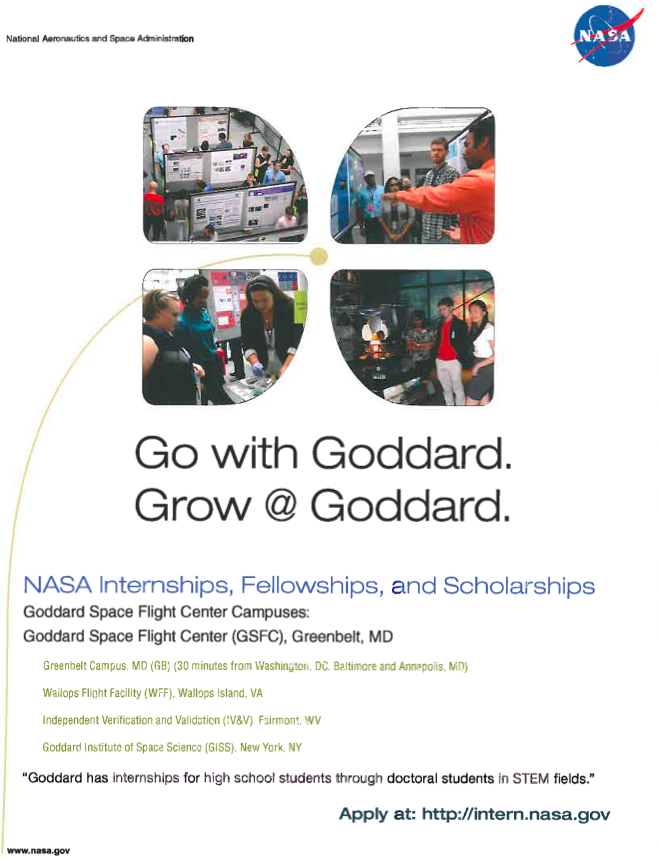 --- NASA's Goddard Space Flight Center anticipates hosting at least 400 student interns this summer ---
NASA's Goddard Space Flight Center in Greenbelt, Md., leads the world in scientific discovery and understanding. Goddard is the home of innovative Earth science, astrophysics, heliophysics and planetary science. The center's diverse and talented team is responsible for each breakthrough emerging from Goddard laboratories. From high school interns to accomplished Nobel Prize winners, each member of the Goddard team plays a vital role in mission success.
Goddard is a science and engineering Center, with enabling technologies like computer science and IT management, to support missions to explore and observe the Earth from space, the study of the sun, exploration of the solar system, and to address big questions such as the origins of life on Earth.
GSFC studies the Earth from space with missions like the Global Precipitation Measurement Mission, or GPM. GPM is an international satellite mission to provide next-generation observations of rain and snow worldwide every three hours, and is scheduled for launch on February 27th.
GSFC studies the Universe and is now building the James Webb Space Telescope. Scheduled for launch in 2018, the JWST is a large space observatory that will operate in an orbit some 1 million miles from Earth to find the first galaxies that formed in the early universe.
--- NASA's Jet Propulsion Laboratory anticipates hosting internships covering at least 45 different research topics! ---
We offer internships and fellowships for undergraduate and graduate students throughout the year. Students are engaged in research projects under the guidance of JPL scientists and engineers, and experience the process of research as a creative intellectual activity. Our goal is to further students' pursuit of careers in science, technology, engineering and mathematics (STEM). Research projects are offered in areas such as computer science, robotics, mechanical engineering, aerospace engineering, astrophysics, electrical engineering, as well as planetary, geological and biological sciences.
In August 2013, JPL was named one of "The 10 Most Awesome College Labs of 2013" by Popular Science.
To learn more about the research conducted at JPL or to contact us please visit:
--- NASA's Goddard Space Flight Center anticipates hosting at least 400 student interns this summer ---
NASA's Goddard Space Flight Center in Greenbelt, Md., leads the world in scientific discovery and understanding. Goddard is the home of innovative Earth science, astrophysics, heliophysics and planetary science. The center's diverse and talented team is responsible for each breakthrough emerging from Goddard laboratories. From high school interns to accomplished Nobel Prize winners, each member of the Goddard team plays a vital role in mission success.
Goddard is a science and engineering Center, with enabling technologies like computer science and IT management, to support missions to explore and observe the Earth from space, the study of the sun, exploration of the solar system, and to address big questions such as the origins of life on Earth.
GSFC studies the Earth from space with missions like the Global Precipitation Measurement Mission, or GPM. GPM is an international satellite mission to provide next-generation observations of rain and snow worldwide every three hours, and is scheduled for launch on February 27th.
GSFC studies the Universe and is now building the James Webb Space Telescope. Scheduled for launch in 2018, the JWST is a large space observatory that will operate in an orbit some 1 million miles from Earth to find the first galaxies that formed in the early universe.
--- NASA's Jet Propulsion Laboratory anticipates hosting internships covering at least 45 different research topics! ---
We offer internships and fellowships for undergraduate and graduate students throughout the year. Students are engaged in research projects under the guidance of JPL scientists and engineers, and experience the process of research as a creative intellectual activity. Our goal is to further students' pursuit of careers in science, technology, engineering and mathematics (STEM). Research projects are offered in areas such as computer science, robotics, mechanical engineering, aerospace engineering, astrophysics, electrical engineering, as well as planetary, geological and biological sciences.
In August 2013, JPL was named one of "The 10 Most Awesome College Labs of 2013" by Popular Science.
To learn more about the research conducted at JPL or to contact us please visit: 